Trades
How a trade fits beside your class
A knight who picks up a pickaxe is still a knight, and now a miner as well.
Your class comes from the weapon in your hand. Your trade comes from the tool on the Trades tab of your character window, so the two never get in each other's way. You keep your sword on while you carry the pick, and the tool only appears in your hands while you work.
Each trade has a level of its own. Fighting does nothing for your mining and mining does nothing for your fighting. As a trade grows you earn points for its tree of passives, and the Trades Guide in the game shows what you can work, where to find it and what it needs.
You can take up every trade on one character. Each one starts with a short quest, and whoever gives it hands you your first tool.
Every trade
Some gather from the world and some make things from what the others bring in.
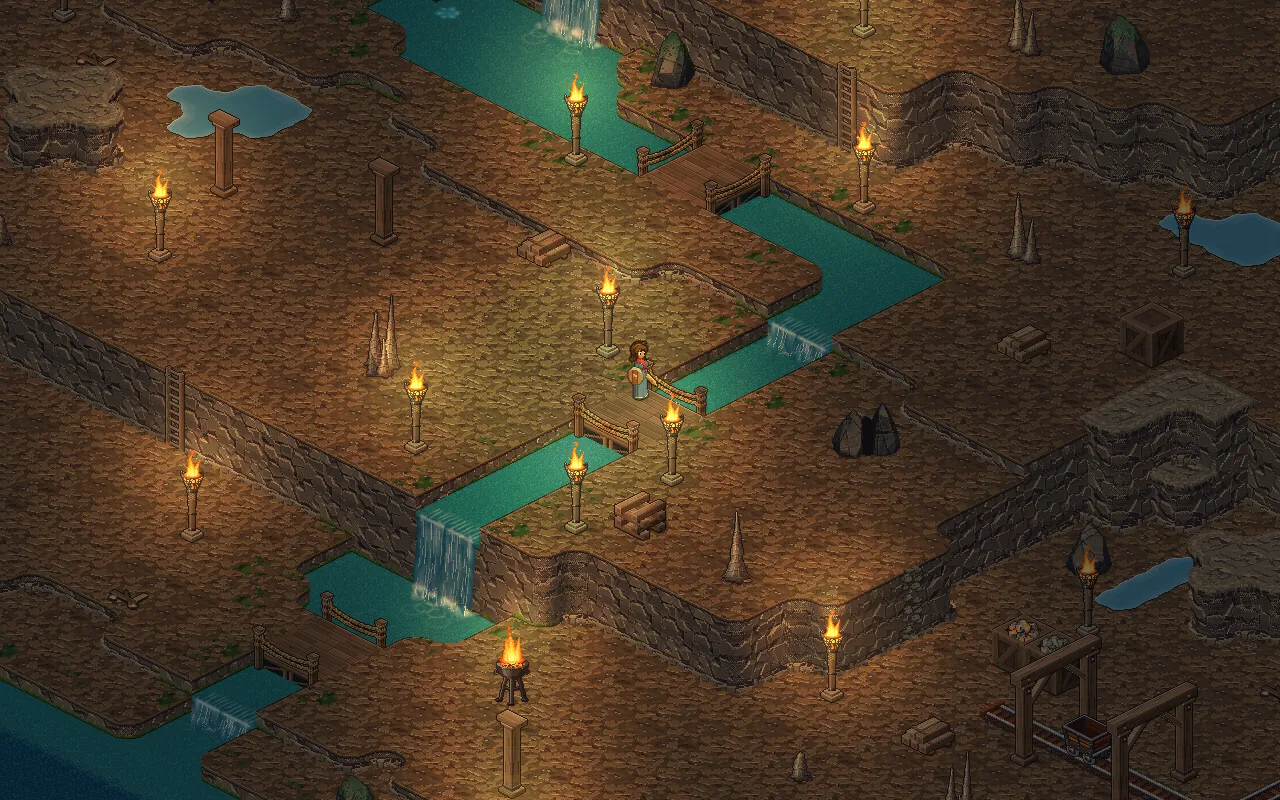
Miner
Works ore out of the rock with a pickaxe.
Find a vein, swing, and the ore is in your bag when the bar fills. Every kind of ore shows in the stone in its own colour, and the rarer ones lie further from town and deeper down.
Woodcutter
Fells timber with an axe.
The trees you can fell have a notch cut in the trunk. A felled tree leaves a stump that grows back, and the strangest timber stands in the wildest country.
Fisher
Casts a line where the fish are, and strikes when one bites.
Cast where fish are moving under the water and wait for the bite. Then strike while the needle is inside the zone. Every water wants its own bait, and the rarer catches want rarer bait.

Reeling one in Smith
Forges metal at the anvil with a hammer.
Melt ore into bars at the furnace and alloy them, then forge them at the anvil into tools, weapons and armour. Now and then a piece comes off the anvil finer than anything a stall sells.
Tailor
Sews leather and cloth at the sewing table with a needle.
Tan hides into leather, spin silk into cloth, and sew both into light armour.
Carpenter
Saws timber and joins it at the bench with a saw.
Saw logs into boards, then build furniture for a room from those boards, a smith's nails and a tailor's cloth.


Better tools are made, not bought
Each tool is made from what the one before it gathers, so the trades climb together.
Your first tool comes from whoever teaches the trade, and they will sell you another if you lose it. Anything better is made by players: a smith forges the metal, a carpenter cuts the handle, and every better tool reaches resources the last one could not.
Those resources are what the next tool is made from, so the gatherers and the makers lean on one another. Logs and ore also become furniture, which is how a trade fills a room of your own. How crafting works.
Good to know
The parts people ask about first.
Veins and trees run out
A vein or a tree gives a handful and then looks worked out. Leave it a while and it comes back.
The tool has to be up to it
Tougher resources ask for a higher trade level and a better tool, so the two grow together.
Work is where the monsters are
Resources are found where the monsters are a match for them, so a place you can work is also a place you can hold your own.
Moving stops the work
Take a step, get hit or start a fight and the work stops. You lose the time and nothing else.